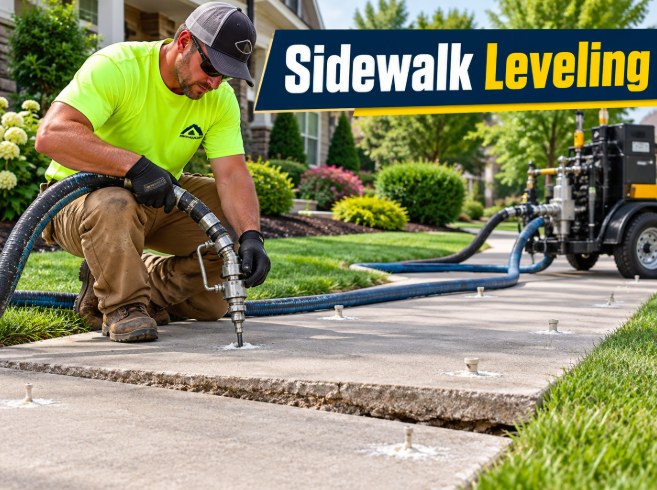
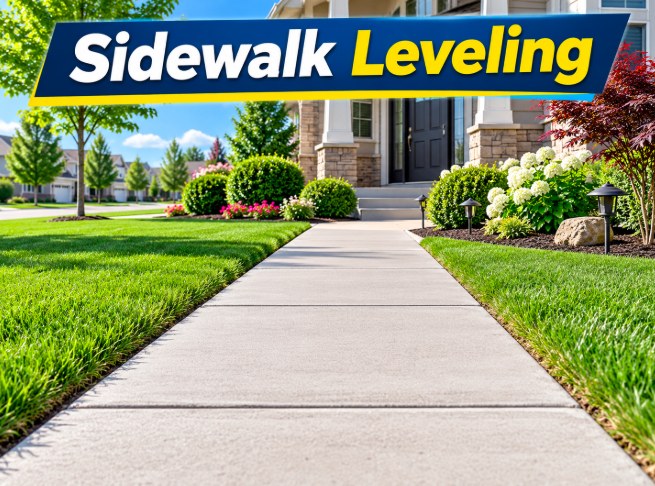
When one concrete panel settles lower than the next, the joint between them can become a trip point. Low sidewalk sections may also collect water, interfere with drainage, or create an uneven approach to a home or business.
Long Beach Concrete Leveling provides concrete sidewalk leveling throughout Long Beach for residential and commercial properties.
We evaluate settled sidewalk panels and determine whether repositioning the existing concrete is appropriate.
What Does Sidewalk Settlement Look Like?
Sidewalk movement is not always dramatic.
Sometimes the first sign is only a slightly uneven joint.
Common problems include:
- Sunken sidewalk panels
- Raised-looking edges caused by neighboring settlement
- Uneven walkway sections
- Low spots holding water
- Slabs dropping near driveways
- Uneven front entrance walks
- Concrete settlement next to landscaping
- Cracked panels with height differences
- Walkways sloping toward a building
- Settlement around gates
- Irregular transitions near steps
These conditions can occur gradually, making them easy to overlook until the difference becomes obvious.
Why Sidewalk Slabs Move
Concrete sidewalks usually consist of multiple individual sections.
Each section rests on soil and base material. If support beneath one panel changes while the neighboring section remains stable, the two slabs can end up at different elevations.
Water Beneath the Concrete
Water may enter through slab joints, landscaping, irrigation, or surface runoff.
If soil particles are carried away, empty spaces can develop beneath the walkway.
Tree and Landscape Conditions
Roots, soil moisture, planting beds, and repeated irrigation can all influence the ground beside a sidewalk.
The result may be movement in one area while nearby concrete stays stable.
Inadequate Base Preparation
A sidewalk installed over poorly compacted material may settle as the ground underneath becomes more compressed.
Natural Soil Movement
Soil changes over time.
Moisture, drying, erosion, and compaction can all affect the support underneath concrete panels.
Trip Hazards on Uneven Sidewalks
The most common concern with sidewalk settlement is the change in height between adjoining sections.
A pedestrian may not notice the difference until a shoe catches the elevated edge.
Uneven surfaces can be particularly troublesome for:
- Children
- Older pedestrians
- Visitors
- Customers
- Delivery workers
- People using strollers
- People using carts
- Wheelchair users
- Property maintenance workers
Leveling the settled panel can create a more gradual and usable walking surface.
Residential Sidewalk Leveling
Residential concrete walkways connect important areas around the home.
We level concrete used for:
- Front walks
- Side-yard paths
- Backyard walkways
- Mailbox access
- Walkways between driveway and house
- Garden paths
- Walks leading to gates
- Walkways near porches
- Concrete between detached structures
A small settlement issue in one panel can interrupt the entire path.
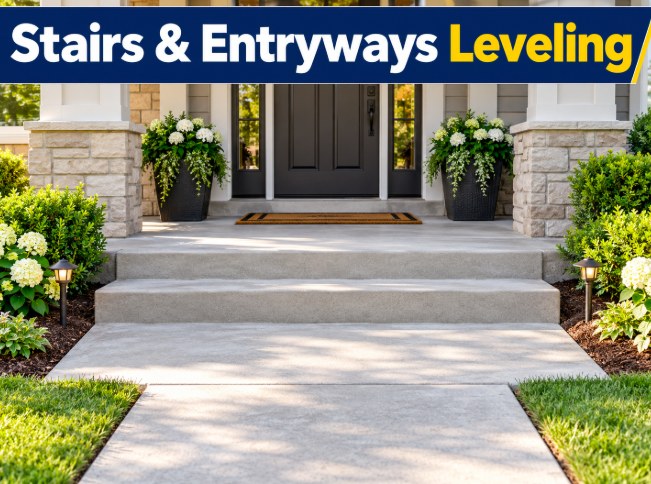
Front Entry Walkways
The path leading to a front door creates one of the first impressions of a property.
A sunken slab near the porch, entrance landing, or front steps may make the walkway feel neglected even when the rest of the property is well maintained.
Leveling can improve the transition without automatically replacing every surrounding section.
Sidewalk Drainage Problems
Low concrete frequently becomes a collection point for water.
After rain or irrigation, a sunken panel may hold a shallow puddle while the rest of the walkway dries.
Standing water may:
- Make the walkway slippery
- Stain the concrete
- Encourage dirt accumulation
- Continue saturating surrounding soil
- Contribute to additional settlement
Where site conditions allow, restoring slab elevation can improve water movement.
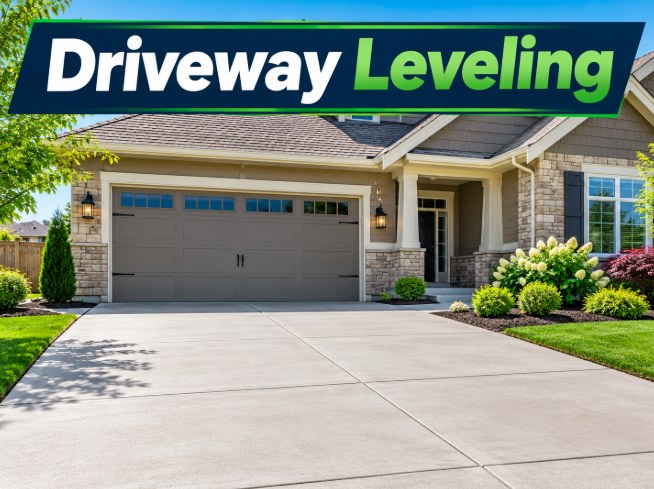
Sidewalk Leveling Near Driveways
Driveways and sidewalks often meet at different angles and slopes.
If a sidewalk panel sinks near the driveway, an awkward transition can form at the intersection.
Our evaluation looks at both surfaces together to avoid simply shifting the problem from one edge to another.
Sidewalk Leveling Around Commercial Properties
Businesses and multi-family properties often have larger pedestrian areas and higher daily traffic.
We provide evaluations for sidewalk settlement around:
- Offices
- Stores
- Apartment buildings
- Warehouses
- Restaurants
- Professional buildings
- Small shopping properties
- Service centers
Commercial walkways may connect parking areas, entrances, loading zones, and public sidewalks.
Maintaining smoother transitions can improve the overall usability of these routes.
Why Level Instead of Replace?
Not every uneven sidewalk panel needs to be removed.
If the slab remains in usable condition and the problem is mainly settlement, leveling may preserve the existing concrete.
Replacement may be more appropriate when a panel is badly broken or deteriorated.
The right choice depends on the actual condition of the slab rather than simply its age.
Advantages of Sidewalk Leveling
Sidewalk leveling may help:
- Reduce abrupt changes in height
- Improve walking conditions
- Improve drainage
- Eliminate certain low areas
- Preserve usable concrete
- Improve curb appeal
- Create smoother transitions
- Reduce the need for extensive demolition
- Improve access around the property
Uneven Sidewalk? We Can Evaluate It
At Long Beach Concrete Leveling, we do not look at only the obvious high edge.
We examine the entire area to understand which slab moved, how the surface connects to nearby concrete, and where water should travel.
That broader approach helps us plan a more useful correction for the property.