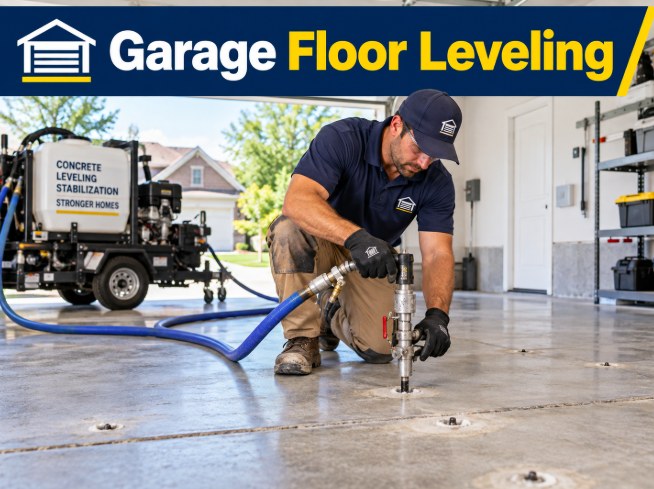
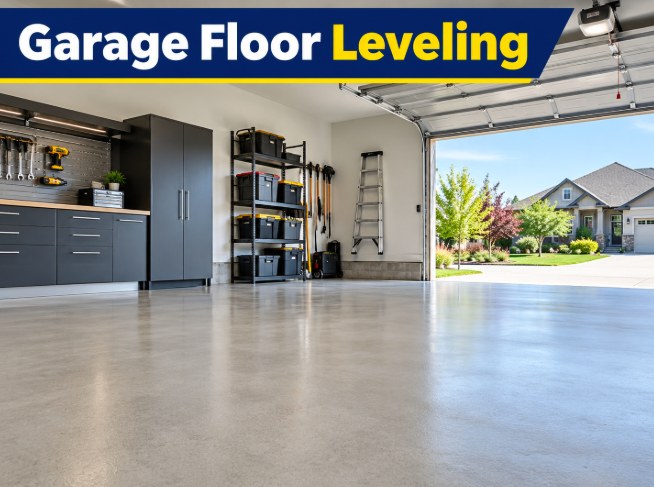
When sections of the concrete floor become uneven, the problem can interfere with normal garage use.
A settled slab may create low areas, drainage problems, irregular transitions at the driveway, or an uncomfortable surface beneath parked vehicles.
Long Beach Concrete Leveling provides evaluation and leveling services for applicable garage floor settlement throughout Long Beach.
Signs of an Uneven Garage Floor
Garage floor movement may appear as:
- Low areas beneath vehicles
- Uneven concrete sections
- Settlement near the garage door
- Cracks with vertical displacement
- Water collecting inside the garage
- Sunken slab edges
- Uneven transitions between garage and driveway
- Gaps at walls or thresholds
- A noticeable slope that developed over time
- Areas that feel different underfoot
Some garage floors are constructed as one large slab, while others may contain separate sections.
The construction type influences how leveling should be approached.
Why Garage Floors Settle
Garage floors depend on properly compacted material underneath the concrete.
If that material changes, the slab may move.
Possible causes include:
- Poorly compacted fill
- Soil erosion
- Water entering beneath the slab
- Plumbing leaks
- Drainage problems
- Voids beneath concrete
- Long-term soil settlement
- Soil shrinkage
- Previous excavation beneath the garage
The cause can vary considerably from one property to another.
Garage Floor Settlement Near the Door
One common problem occurs along the garage entrance.
The floor may remain relatively stable while the driveway settles, or the garage slab itself may move.
The result can be an uneven transition under the garage door.
This may affect:
- Vehicle movement
- Door seals
- Water entry
- Walking access
- Appearance
We evaluate both the garage slab and exterior driveway before recommending a correction.
Low Spots and Water Collection
Garages can receive water from vehicles, cleaning, weather, or outdoor runoff.
If a section of floor has settled, water may remain in a depression rather than moving toward the intended exit or drain.
Persistent low spots can create staining, dampness, and inconvenience.
Where the slab configuration allows, leveling may help restore a more useful surface position.
Garage Floor Cracks
Not every crack indicates a leveling problem.
Concrete naturally develops some cracking over time.
The more important question is whether sections on opposite sides of the crack have moved vertically.
A crack where both sides remain at approximately the same elevation is different from a crack where one section has dropped.
We focus on the movement pattern rather than the crack alone.
Garage Floor Leveling for Workshops
Many garages function as workshops.
An uneven slab may make it difficult to position:
- Tool cabinets
- Workbenches
- Storage racks
- Equipment
- Automotive tools
- Machinery
Leveling a settled section can improve the usefulness of the working area.
Garage Floor and Foundation Considerations
A garage floor slab is not always the same thing as the building foundation.
Settlement involving only the interior slab may require a different approach from structural foundation movement.
It is important to distinguish between:
- Garage slab settlement
- Foundation settlement
- Wall movement
- Structural cracking
- Driveway settlement
If signs indicate a broader structural issue, additional evaluation may be necessary.
Attached and Detached Garages
We evaluate applicable concrete settlement in:
- Attached garages
- Detached garages
- Single-car garages
- Two-car garages
- Multi-car garages
- Residential workshops
- Accessory structures
Each layout presents different fixed points and drainage conditions.
Benefits of Garage Floor Leveling
Leveling may help:
- Reduce low spots
- Improve vehicle parking surfaces
- Improve garage-door transitions
- Improve interior drainage
- Reduce uneven walking areas
- Improve workspace usability
- Preserve existing concrete
- Correct certain settlement-related elevation differences
Leveling or Garage Floor Replacement?
If the slab is substantially intact, leveling may be an alternative to demolition.
Replacement may be necessary when:
- Concrete is severely damaged
- Large sections are fragmented
- Structural issues are present
- The slab cannot be repositioned safely
- A complete garage renovation requires a new floor
We evaluate existing conditions before determining what approach makes sense.
Professional Garage Floor Evaluation
At Long Beach Concrete Leveling, we examine the garage as a complete system.
We consider the driveway, door opening, walls, interior drainage, cracks, slab elevation, and surrounding property.
That helps us determine whether the issue is isolated concrete settlement or part of a larger problem.