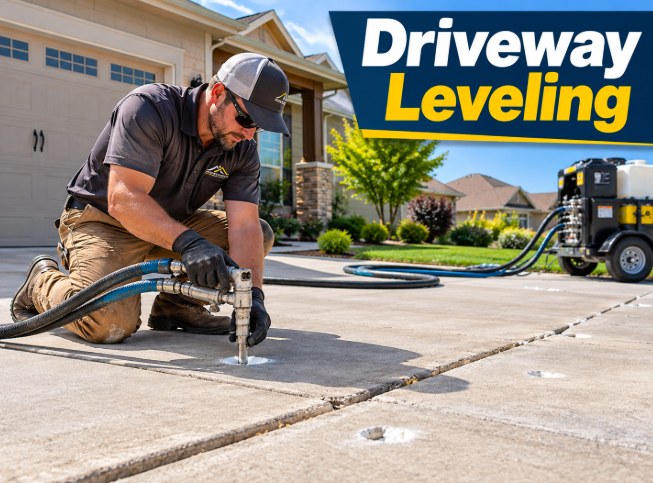
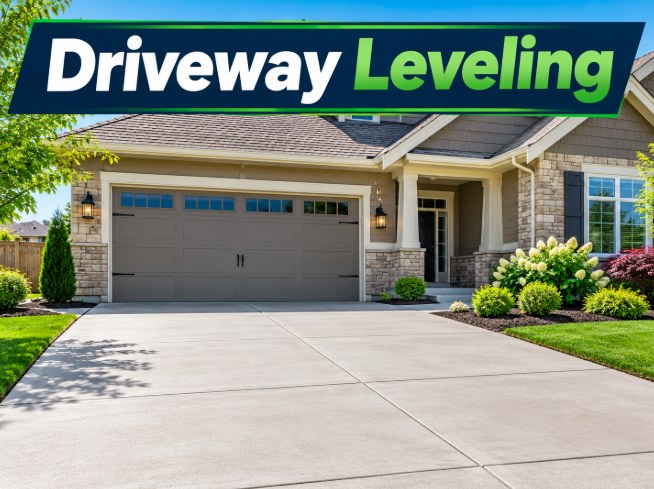
Long Beach Concrete Leveling provides professional driveway leveling services for residential and commercial properties throughout Long Beach, California. Our goal is to restore the position of settled concrete whenever the slab remains suitable for leveling instead of complete removal and replacement.
Every driveway is different. Some settle close to the garage, others sink near the sidewalk or street, and larger driveways may have several areas moving at different rates. We inspect the overall surface before determining how individual sections should be corrected.
Common Driveway Problems We Level
Driveway settlement can show up in many different ways, including:
- Sunken concrete driveway slabs
- Uneven joints between concrete sections
- Low spots that collect water
- Raised edges between neighboring slabs
- Driveway settlement near the garage
- Uneven driveway-to-sidewalk transitions
- Concrete sinking near the curb
- Slabs that rock or feel unsupported
- Cracking caused by differential settlement
- Driveways sloping in the wrong direction
- Gaps forming beneath concrete edges
- Uneven parking surfaces
Even when the concrete itself still looks relatively solid, changes in elevation can affect how the driveway performs.
Why Concrete Driveways Sink
Concrete slabs depend on the ground beneath them for support. When that support changes, the slab may move.
Several conditions can contribute to driveway settlement.
Soil Compaction
Fill soil placed during construction may continue compressing long after a driveway is poured. When the material below a slab becomes denser, a space can form underneath the concrete and allow it to settle.
Water Movement
Rain, irrigation, broken drainage systems, and runoff can move through soil underneath a driveway. Over time, fine soil particles may wash away and create unsupported areas beneath the slab.
Poor Drainage
Water that repeatedly collects beside or beneath a driveway can soften supporting soil. This may allow sections of concrete to sink gradually.
Vehicle Weight
Driveways carry repeated vehicle loads. Passenger vehicles, work vans, trucks, trailers, and other heavy equipment can place additional pressure on weak areas of the base.
Soil Expansion and Shrinkage
Changes in moisture levels can cause certain soils to expand when wet and shrink when dry. Repeated changes can contribute to uneven movement.
Driveway Leveling Near the Garage
The garage entrance is one of the most common places where settlement becomes noticeable.
If the driveway sinks while the garage floor remains at its original elevation, a step or lip may form where the two surfaces meet. Drivers may feel a bump each time they pull into the garage.
A properly planned leveling project can raise the settled driveway section to create a smoother transition.
Our technicians evaluate the driveway and garage floor together rather than treating the low slab as an isolated problem.
Correcting Uneven Driveway Slabs
Concrete driveways are commonly divided by joints into individual sections. This allows different sections to move independently.
One slab may remain stable while the section directly beside it sinks.
The result can be an uneven joint that creates:
- A noticeable vehicle bump
- A pedestrian trip point
- A location where water accumulates
- An unattractive stepped appearance
Leveling the lower section can reduce the height difference and restore a smoother surface.
Driveway Drainage and Leveling
Concrete leveling is not only about appearance.
The position of the slab also affects where water travels.
A driveway that has settled in the wrong direction may send water toward:
- A garage
- A foundation
- A walkway
- Landscaping
- A neighboring concrete section
Low areas can also hold standing water after rain or washing a vehicle.
During our evaluation, we look at the relationship between settled slabs and the surrounding drainage pattern.
When Driveway Leveling May Be a Good Choice
Leveling may be worth considering when:
- The concrete remains substantially intact
- One or more sections have settled
- The primary issue is elevation rather than severe deterioration
- The slabs have usable structural condition
- Replacement would remove otherwise serviceable concrete
Not every driveway can or should be leveled.
Concrete that is severely broken, extensively deteriorated, badly spalled, or fragmented into many unstable pieces may require replacement instead.
Driveway Leveling Versus Replacement
Complete replacement requires removing existing concrete, hauling away debris, preparing the base, installing forms, pouring new material, finishing the surface, and waiting for the new concrete to cure.
Leveling takes a different approach.
Instead of discarding an otherwise usable slab, the goal is to reposition the existing concrete.
This can make leveling an attractive option when settlement is the main problem.
Benefits of Driveway Leveling
Professional driveway leveling can help:
- Improve vehicle entry and exit
- Reduce uneven slab transitions
- Improve pedestrian movement
- Reduce areas of standing water
- Improve the appearance of the driveway
- Restore more appropriate surface elevations
- Preserve existing concrete
- Reduce unnecessary demolition
- Improve transitions near garages and sidewalks
Residential Driveway Leveling
We work with homeowners dealing with settling driveways of many sizes and configurations.
Common residential projects include:
- Single-car driveways
- Double driveways
- Wide residential driveways
- Concrete parking pads
- Driveways connected to garages
- Side-yard parking areas
- Shared driveway sections
We evaluate how the driveway connects with fixed surfaces before deciding on the desired final elevation.
Commercial Driveway Leveling
Commercial concrete experiences different traffic patterns than residential driveways.
Settled areas may affect customers, employees, delivery vehicles, service vehicles, or loading operations.
We can evaluate concrete around:
- Small businesses
- Apartment properties
- Offices
- Warehouses
- Retail buildings
- Service facilities
- Multi-unit properties
Why Address Driveway Settlement Early?
Settlement does not always stop after a slab moves once.
If erosion, drainage, or weak supporting material remains present, the condition can become more noticeable.
Uneven concrete may also place additional stress on adjoining slabs.
Having the area inspected early can help you understand the condition before the elevation difference becomes more severe.
Driveway Leveling from Long Beach Concrete Leveling
At Long Beach Concrete Leveling, our approach begins with understanding why the driveway is uneven and how the affected slab relates to the surrounding property.
We look at the garage entrance, neighboring slabs, street transition, sidewalks, drainage, landscaping, and visible signs of settlement.
The goal is straightforward: provide a practical leveling solution that improves how the driveway looks, drains, and functions.